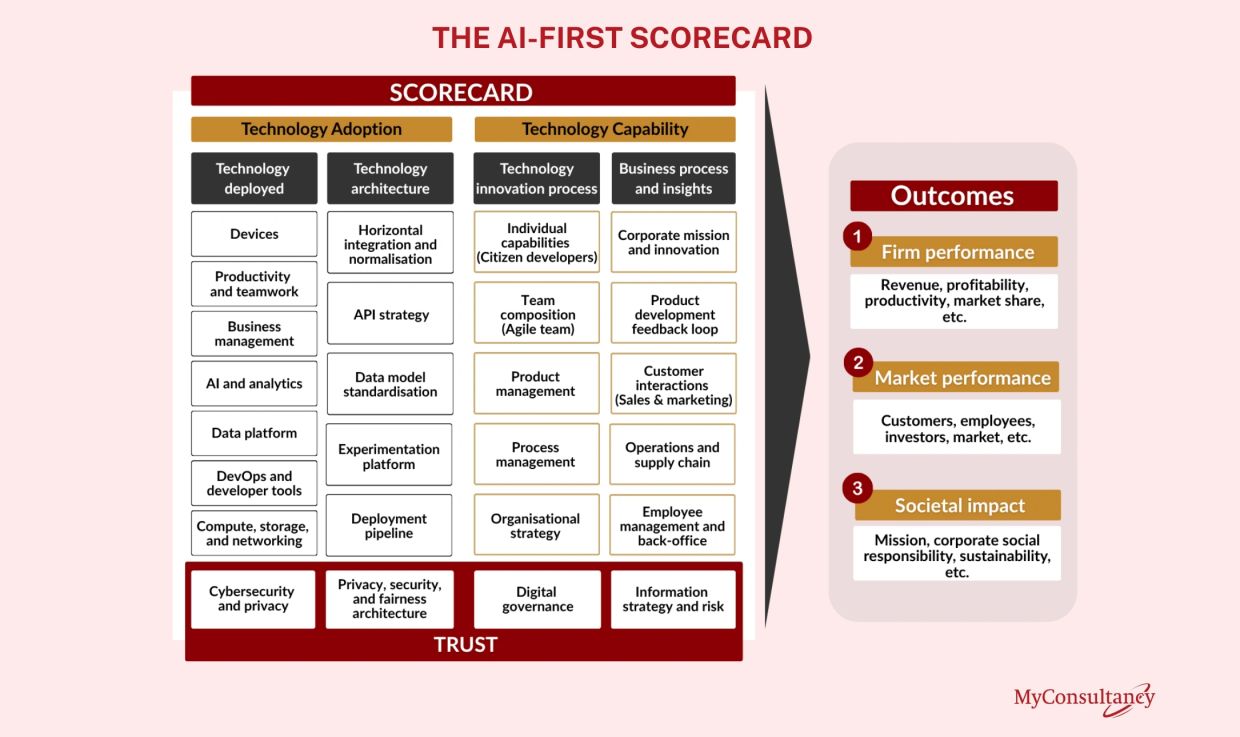
The AI Transformation Framework
Lead AI. Organise AI. Govern AI. Execute with discipline.
Most organisations do not have an AI problem. They have a structural problem that AI exposes.
The pilots work. The technology performs. Yet when organisations attempt to scale, initiatives stall, accountability blurs, and the expected value fails to materialise.
The constraint is rarely the algorithm. It is the enterprise system around it: how leaders set direction, how the operating model is designed, how governance holds behaviour within boundaries, and how execution is sustained.
Lead AI sets direction. Organise AI creates the structure. Govern AI defines the boundaries. Execute AI turns the system into measurable outcomes.

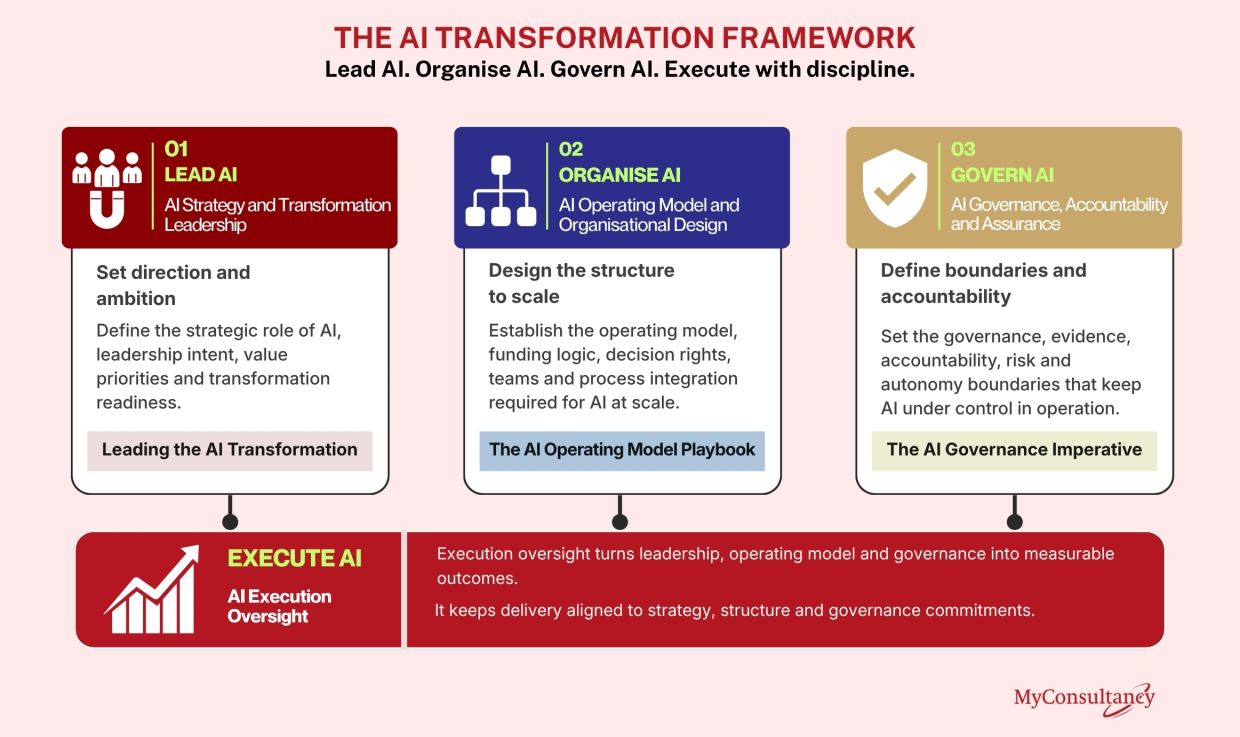
The AI Transformation Framework: Three pillars, Lead AI, Organise AI, Govern AI, standing on a single execution layer, Execute AI, that turns them into measurable outcomes.
Lead AI: AI Strategy and Transformation Leadership
Establishes why AI matters, how value is created, and what leaders must change to move from experimentation to enterprise transformation.
AI transformation begins with leadership. Leaders must decide what role AI should play in the enterprise, where it creates value, how ambition should be prioritised, and what capabilities must be built before scale is attempted.
- What strategic role should AI play, and what does that mean for how we compete?
- How do we prioritise across a portfolio of AI initiatives without killing the work that matters?
- How do we govern risk, ethics, and responsible adoption before scale amplifies consequences?
- How do we align business and technology teams around outcomes rather than activity?
Draws from: Leading the AI Transformation

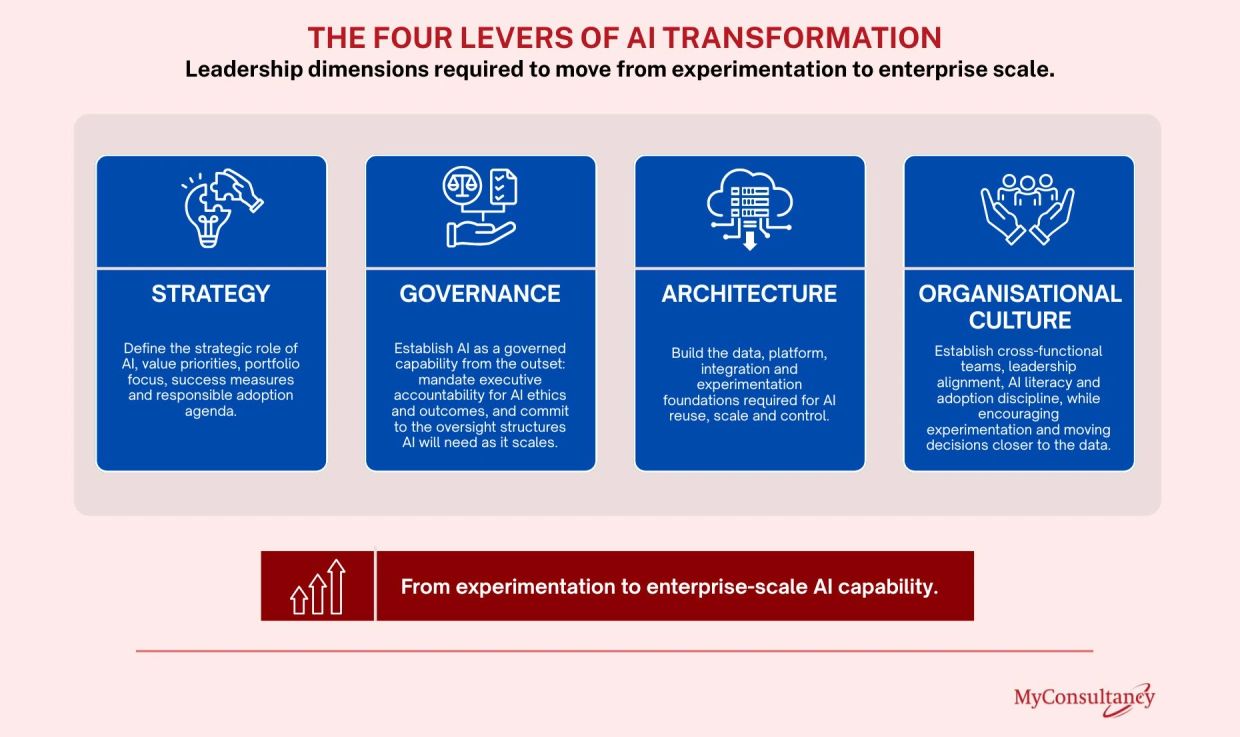
The Four Levers of AI Transformation: Leadership dimensions required to move from experimentation to enterprise scale.
The AI Transformation Maturity Model provides a structured lens to assess where an organisation stands and what capabilities must be built next, from siloed experimentation to becoming an AI native enterprise.

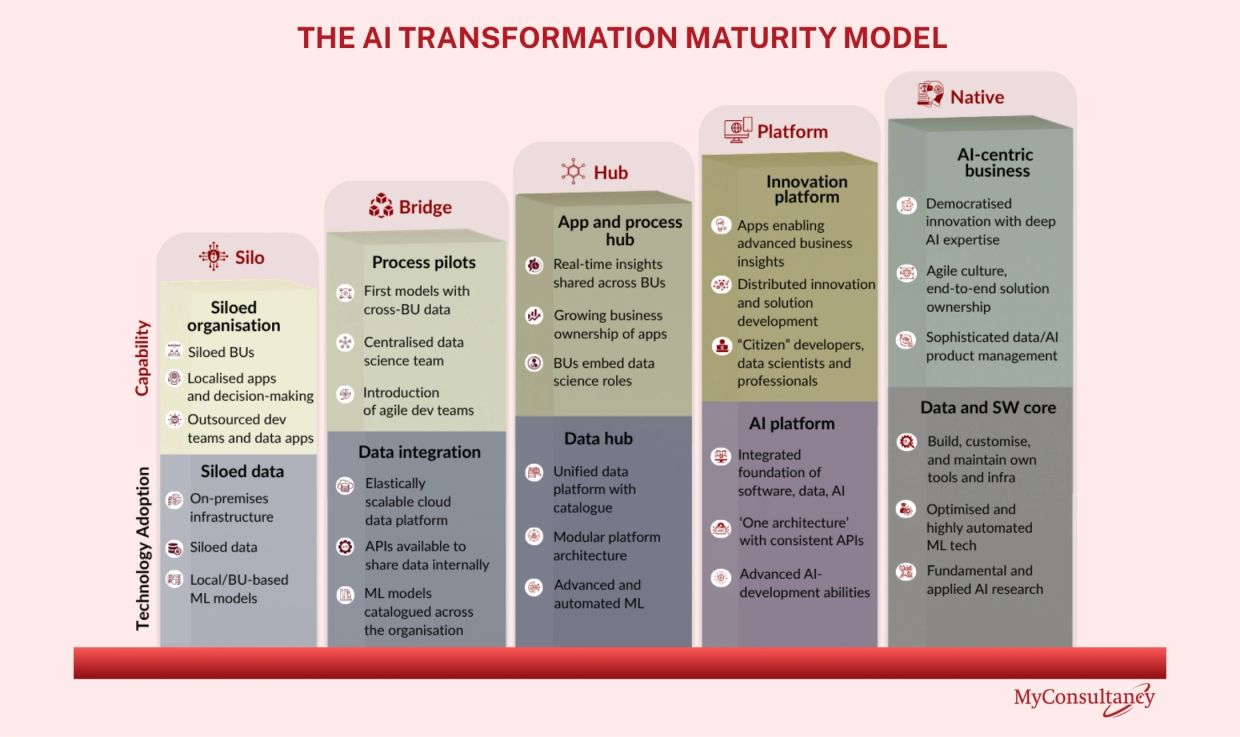
The AI Transformation Maturity Model: How organisations progress from experimentation to enterprise scale AI capability.
Organise AI: AI Operating Model and Organisational Design
Shows how portfolio discipline, funding, decision rights, teams, processes, risk and measurement must be structured so AI can scale.
Leadership sets direction, but the operating model determines whether AI scales or stalls. Traditional operating models were designed for predictable processes and stable decision structures, optimised for control and for minimising variation. AI introduces systems that learn, adapt and improve through exposure to variation, which is precisely what those models were built to suppress.
Draws from: The AI Operating Model Playbook

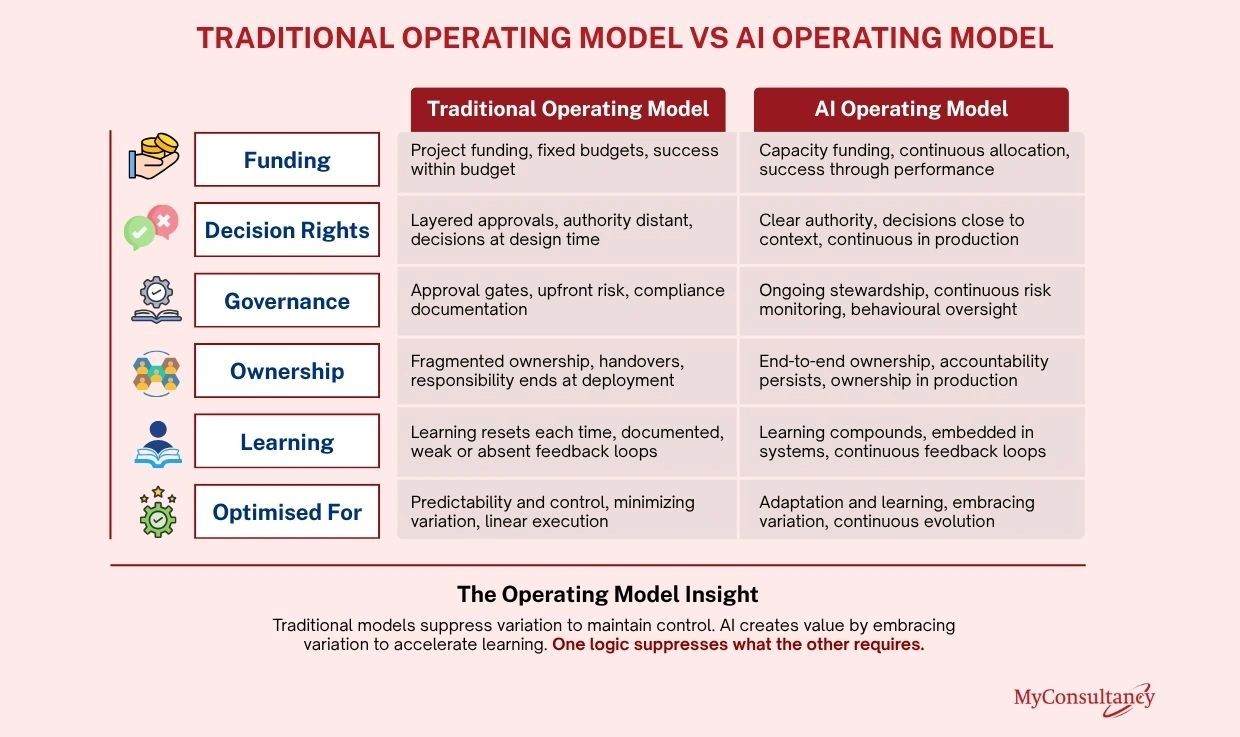
Traditional Operating Model vs AI Operating Model: The structural incompatibility across funding, decision rights, governance, ownership, learning, and what each model optimises for.
This incompatibility cannot be resolved by adjusting existing processes. It requires a new operating model, built for AI from the ground up, addressing eight structural elements, two of which, decision rights and funding, are exactly where the incompatibility above is sharpest.
Organisations that successfully scale AI address eight structural elements:
- Portfolio Discipline: managing AI initiatives as a governed portfolio with clear prioritisation and the discipline to stop what is not working
- Funding Logic: moving from project based funding to sustained capability investment
- Decision Rights: defining accountability when algorithms influence decisions
- Team Structures: enabling cross functional teams to build and scale AI continuously
- Process Integration: embedding AI directly into core workflows
- Risk Stewardship: governing risk, ethics, and compliance without slowing progress
- Value Measurement: linking AI initiatives to measurable business outcomes
- Scaling Commitment: ensuring leadership alignment and long term investment to scale
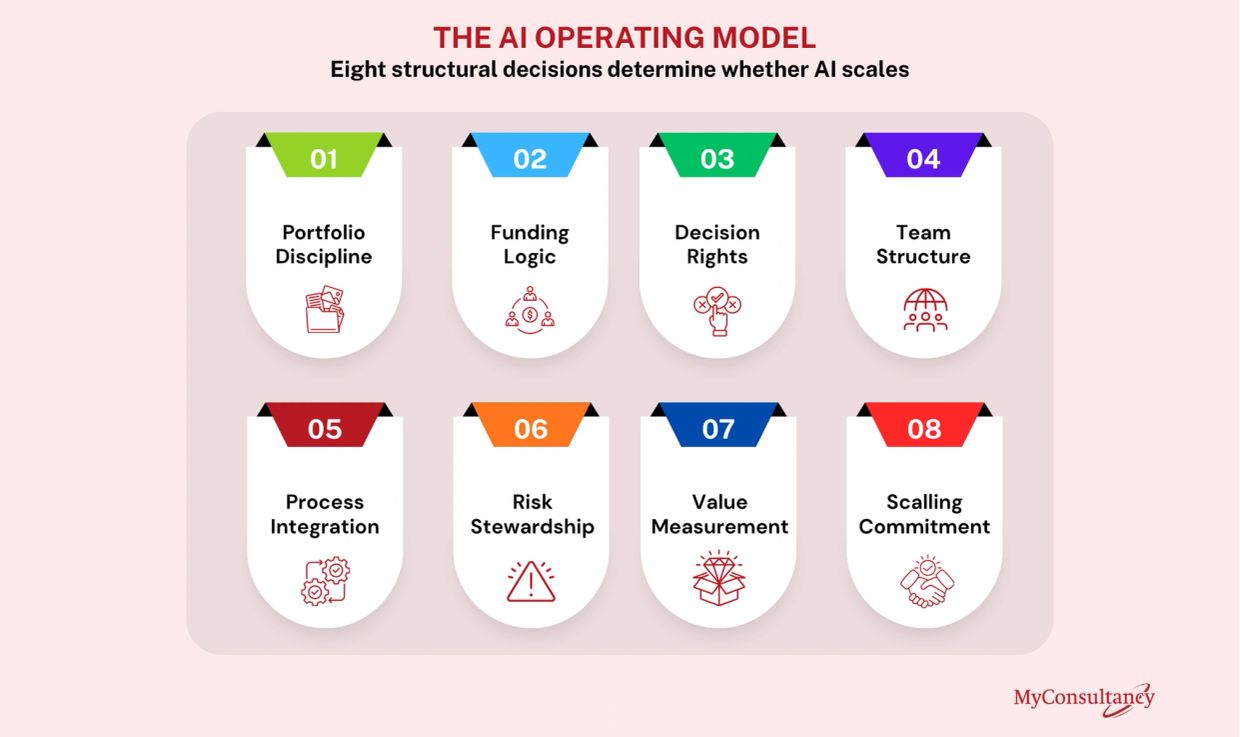
The AI Operating Model: Eight structural elements that determine whether AI scales across the enterprise.
Govern AI: AI Governance, Accountability and Assurance
Defines how AI behaviour, evidence, accountability, vendor risk and autonomy must be governed once AI operates in the enterprise.
Once AI moves from experimentation into enterprise operation, governance must move from approval to behaviour. Most organisations approve an AI system once and treat that approval as permanent, even as the system's behaviour drifts in production. The Behavioural Envelope converts approval into a continuous evidence obligation: thresholds, escalation triggers and named owners operating in production, not a policy filed at launch.
The AI Governance System is the map. It groups seven governance disciplines into three tiers: strategic, where the board approves and the portfolio prioritises; operational, where the operating model runs, risk and assurance monitors, and regulatory evidence proves; and accountability, where ownership sits and autonomy governance extends the boundary as systems act with less human intervention. All seven converge on one thing: the Behavioural Envelope.
Draws from: The AI Governance Imperative

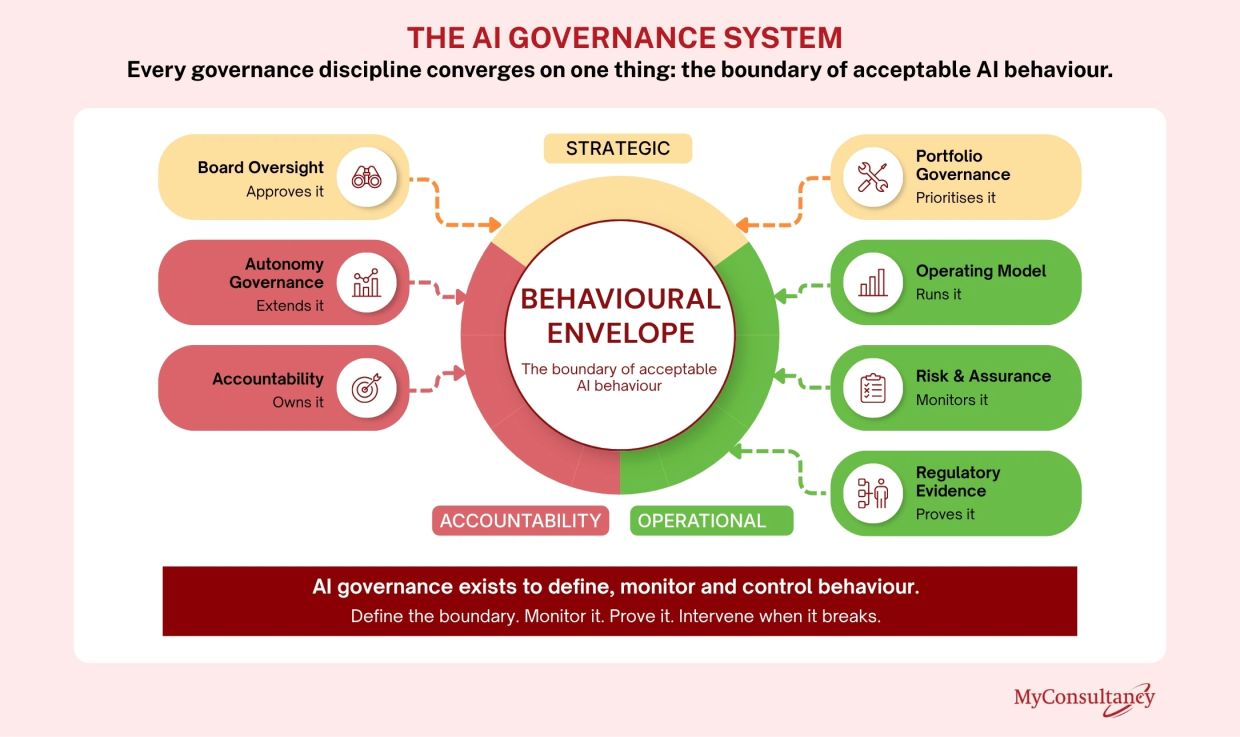
The AI Governance System: Seven governance disciplines across three tiers, strategic, operational and accountability, all converging on the Behavioural Envelope.
The Behavioural Envelope is the operating model underneath the map. The board approves it, management operates within it, and evidence proves it holds, across six measured dimensions of behaviour. When actual behaviour approaches a limit, the system flags it for escalation; when a limit is crossed, that is a breach, and the response runs in sequence: escalate, assess, intervene.
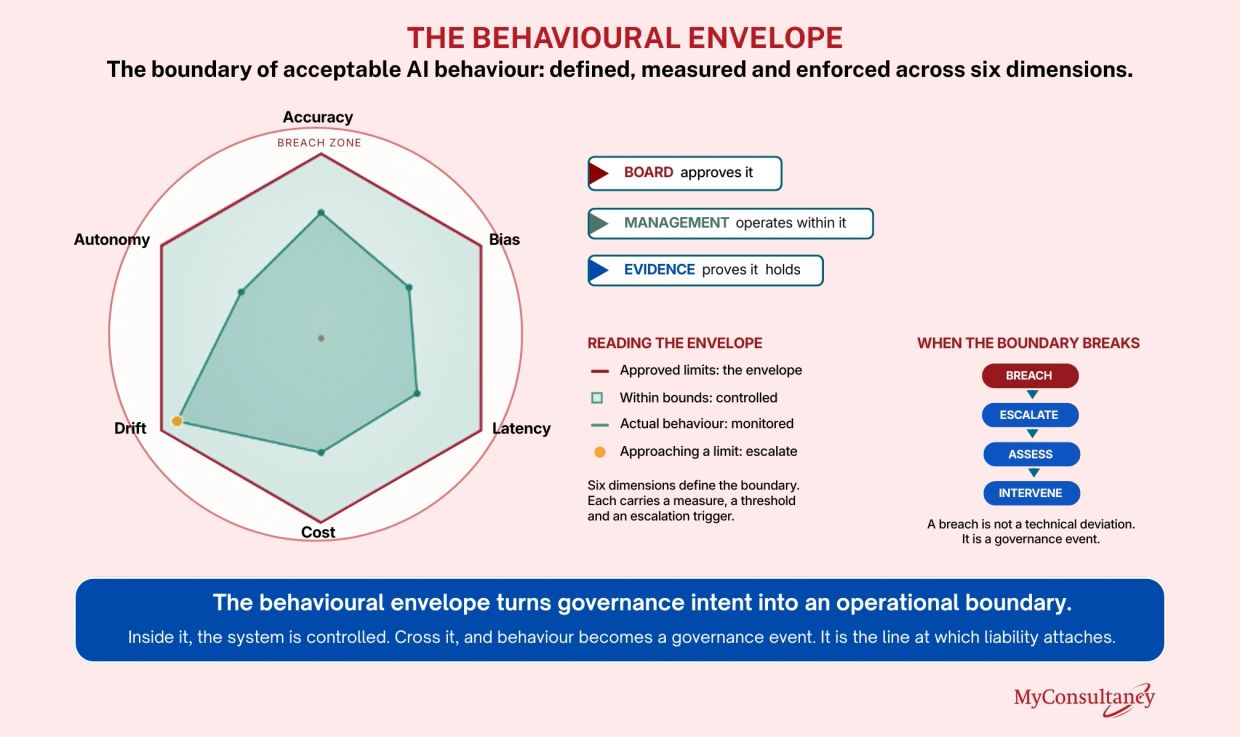
The Behavioural Envelope: Approved by the board, operated within by management, and evidenced continuously across six dimensions of behaviour.
Execute AI: Execution Oversight Across the System
Execution is not a separate pillar. It is the result of the three pillars working together.
AI Execution Oversight keeps delivery aligned to the strategy leaders have set, the operating model the organisation has designed, and the governance boundaries it has approved. This is where the framework becomes delivery discipline: initiatives are prioritised, risks are escalated, outcomes are tracked, and value is realised. This is delivered through MyConsultancy advisory and embedded senior leadership engagements.
The AI First Scorecard measures that progress. Originally from Leading the AI Transformation, it links technology adoption, organisational capability and trust to strategic outcomes, which makes it the right measure to close the whole framework with rather than any single pillar: it is inherently cross-cutting, the same integration logic Execute AI itself represents.